
“And… her light is accomplished, according to the sign of the year…” – 1 Enoch 78:7
One of the main issues that various interpretations of the Biblical Calendar that inevitably arises is that of intercalation (be it Hillel, Sighted Moon/Aviv-Barley, some variation of Enochian, Creator’s Calendar, or Tzadok Priestly Calendar). Intercalation is the insertion of an additional day, week, month, or period of time to maintain alignment between different cycles, such as lunar months and the solar year, or a 364-day calendar with the 365.2424-day annual cycle of the Sun. This process involves some kind of method of adjustment to synchronize, or recalibrate, a set system of time-keeping with the natural cycles of celestial bodies and seasonal changes here on Earth. On a 364-day calendar the beginning of the year can be determined through a method that establishes the Fourth Day of the week as its fixed starting point, uses the spring equinox as the initial astronomical reference, and employs a full-moon verification to determine when a separate seven-day intercalary period is necessary, thereby preserving the structure of the 364-day calendar.
The Dead Sea Scrolls provide evidence within the calendrical manuscripts 4Q319 and 4Q320 which indicate that the priestly class living in the Judean desert during the second temple period may have fixed the start of the year to the 4th day of the week. This would have been in accordance with the 4th day of Creation, when the lights in the heavens were put in place for time-keeping purposes. However, it should be noted that the surviving manuscripts are fragmentary, and reconstructed or editorially restored words should be distinguished from what we can read in the texts themselves, particularly where brackets indicate missing text. That said, the scrolls provide intriguing textual evidence worth exploring.
In addition to fixing the start of the year to the 4th day of the week, 1 Enoch chapter 74 includes passages that describe the 364-day framework, and the roles of the sun and moon in this time-keeping process. The method of recalibration that is being suggested here is that of using the equinox and full-moon to determine a time when an intercalation period of one week is appropriate. The procedure is being proposed as a method of applying that framework, but it should be noted that this procedure is not explicitly spelled out in the texts, but has been interpreted and extrapolated. In no way is this being proposed as definitive, but I believe that there is strong evidence to support the claim. That being said, this is not a closed discussion, and this process is open to correction and new revelation.
Knowing when to start the Biblical year is important because the beginning of the year establishes the foundation for the appointed times (mo’edim). A calendar must provide a consistent and orderly means of determining the annual cycle. The 364-day calendar provides a structure of exactly 52 weeks, allowing the days of the year (and the mo’edim) to maintain their established weekday positions. With this method, a mo’edim will never be on the same day as the weekly Sabbath (the 7th day of the week), and will always occur on the same day of the 7-day week.
The purpose of the method being presented here is to utilize the textual evidence from ancient Biblically-based time-keeping traditions, and establish a working system that recognizes the Fourth Day as the fixed weekday for the beginning of the year, uses the spring equinox as an astronomical reference point, and applies a full-moon verification when the equinox occurs after the candidate New Year. When these qualifying signs occur, that is when we know that it is time to introduce a separate seven-day intercalary period. The objective is to maintain the 364-day calendar structure while using the equinox and full moon as astronomical indicators for determining when an additional week is necessary.
The foundational textual evidence for a year consisting of 364 days can be found in 1 Enoch 74:10, 74:12, 82:6, and Jubilees 6:32, and 6:38. 1 Enoch describes a 364-day year divided into four quarters with months lengths of 30-days, 30-days, and 31-days, totaling 91-days per quarter, and comprising of 52 complete weeks. The extra days at the end of each quarter are themselves called “intercalary days” in most English translations. We will return to this significant point when discussing the role of the stars.
Since each year contains exactly 52 weeks, and because 364 is divisible by seven, the beginning of each year maintains the same weekday, that being the Fourth Day of the week. Thus, the “candidate” for the first day of the first month (i.e., the New Year) must always fall on the Fourth Day of the week. The Fourth Day provides the fixed weekday reference for calculating the calendar. Additionally, the spring equinox is evaluated by observation year-by-year in relation to its position and vicinity to the candidate Fourth Day. Thus, the spring equinox is the first sign for when to start the New Year.
Genesis 1:14–19 establishes the heavenly lights for signs, appointed times, days, and years. This occurred on the Fourth Day of Creation. The sun, moon, and stars are associated with the ordering and measurement of time, and the Fourth Day is therefore an important consideration when examining the calendar’s structure.
In addition to 1 Enoch and Jubilees, the Dead Sea Scrolls provide textual evidence for the Fourth Day start for a new year. Of particular interest are scrolls 4Q319 (4QOtot, or signs) and 4Q320. The textual evidence in 4Q320 provides a reference to the appearance of a heavenly light that rises in the East and shines through the night on the Fourth Day of the week. We can infer that this light is a full moon, since a full moon will rise in the east and shine from evening to morning. The particular verse of interest reads:
“To become visible from the East [and] shine [in] the center of the sky, at the base of [the vaul]t, from evening to morning, on the 4th (day) of the week of [the sons of Ga]mul, in the first month of the [fir]st year…” – 4Q320, Column I.
4Q320 references a full-moon appearing on the Fourth Day of the week during the priestly course of Gamul, and mentions that it occurs in the first month. This scripture demonstrates the relationship between the appearance of the full-moon, the priestly courses, and a connection to the fourth day at the beginning of a calendrical cycle. (It should be noted that the DSS also mention other phases of the moon, so those aren’t being discounted. The other phases of the moon are not the focus of this particular study, and are a topic for future research that will undoubtably reveal more truth as to the processes of using the heavenly bodies for time-keeping purposes.)
The reference to the sons of Gamul and the Fourth Day are significant, as can be seen in 4Q319 (4QOtot):
“Its light [appeared] on the fourth day of the wee[k …] [… the] creation. In the fourth (day) Ga[mul …]” – 4Q319, Column IV
There is a clear reference to the Fourth Day, which is also connected to the creation, and the mention of Gamul. It is possible from these texts to infer a relationship between the Fourth Day, the Creation, and the priestly courses. This relationship is viewed within the context of the process of sacred time-keeping. 4Q319 lists an alternating sign between the courses of Gamul and Shecaniah, and it is likely that these respective “signs” (Otot) are indicative of the beginning of the year.
The significance of these two witnesses is that both 4Q319 and 4Q320 preserve calendrical references associated with the Fourth Day. The DSS texts provide historical evidence for correlating the relationship between the weekly cycle, the heavenly lights, and priestly courses for time-keeping purposes. These references provide strong evidence that support the Fourth Day as the fixed weekday for the candidate of the first day of the first month, i.e. when to begin the New Year.
The spring equinox is considered the first of these signs for when to start the 364-day year because the spring equinox provides an astronomical reference point for the beginning of the annual cycle. It is an indicator that clearly marks the seasonal transition into spring. Since the sun’s cycle is 365.2424 days long, it will not return to the same day of the week on an uninterrupted 7-day cycle. Therefore, its positional relationship to the candidate for the day to begin a New Year is evaluated before determining whether an intercalary week is necessary.
Since the year is 364 days long, it is quite simple to identify the complete 1-through-7 day week in which the candidate day for when to begin the New Year. Simply determine day 364 and then identify the next day, which, after 52 weeks, will be on the Fourth Day of the week (if started on the Fourth Day of the week). Once that Fourth Day is identified, evaluate where the spring equinox is in relation to that particular day, and note if it is before or after within the 7-day week.
The first sign to investigate: Does the spring equinox occur after that Fourth Day that is the possible candidate to begin the New Year? If NO: No full-moon verification is required, and no intercalary week is inserted. If YES: Proceed to the full-moon verification.
The Full Moon serves as the second sign (Second Witness) used for verification. When the spring equinox occurs after the Fourth Day that is considered the candidate to begin the New Year, then we turn to the full-moon for verification. For this method we are going to examine the 14-day period after said Fourth Day for a full-moon occurrence. (While researching this method, I ran various tests including checking for the full moon one week before the Fourth Day, one week after the fourth day, a combination of both, and the 14-day period after the Fourth Day. After looking at the data, an elegant pattern arose that is quite consistent, which will be elaborated upon in another article. For the method being proposed, I settled on searching for the full-moon during the 14-day period after the Fourth Day if the equinox occurred after said Fourth Day. This area deserves more study, but for now we are settling on the current methodology that is being explained.)
For the 14-day Examination of the Full-Moon, begin counting from the candidate Fourth Day that would begin the New Year. Examine the 14 calendar-days immediately following that day, and identify whether an astronomical full-moon occurs within that period. There are two possible outcomes:
- If no full moon occurs within the 14-day period, do not insert an additional week.
- If a full moon occurs within the 14-day period, insert a separate seven-day intercalary week immediately before New Year.
The Second Witness verification is important because the full moon serves as the second astronomical sign in this method. It is not an independent trigger; it is considered only after the equinox test has been verified. When both conditions are met an additional week is inserted. The spring equinox occurs after the Fourth Day, and a full moon occurs within the 14 days following the same Fourth Day. If both requirements are satisfied, the New Year moves forward seven calendar days to the next Fourth Day; the actual New Year consequently begins seven days later.
Because seven days constitute one complete week, moving the New Year forward seven days preserves the Fourth Day weekday designation. The current understanding is that the intercalary week is a distinct seven-day period that is not counted as part of the preceding 364-day year, nor is it counted as part of the following 364-day year. The regular calendar year continues to contain exactly 364 days.
Applying the Method to 2027: (Note: we are not concerned with Gregorian dates; the equinox must be considered in relation to the Fourth Day, rather than a Gregorian calendar date. However, Gregorian dates are often used for easy reference and familiarity.)
- Establish the candidate day for the New Year
- Candidate date: March 17, 2027.
- March 17 falls on Wednesday, the Fourth Day.
- Evaluating the spring equinox
- The spring equinox occurs Saturday, March 20, 2027, after the candidate Fourth Day.
- The full-moon verification is therefore activated.
- Perform the full-moon verification
- The 14-day period after the candidate Fourth Day is then examined for the potential of a full-moon.
- The full-moon occurs on Monday, March 22, 2027.
- This full-moon satisfies the second condition.
- Applying the intercalation
- Insert a separate seven-day intercalary week, and the actual New Year moves from March 17 to March 24, 2027, which is also the Fourth Day.
- The regular 364-day year begins March 24, 2027.
- The year consists of 52 complete weeks.
- The next candidate New Year is calculated 364 days later.
“And the moon brings in all the years exactly, so that they do not advance or delay their position by a single day unto everlasting; but complete the years with perfect justice in three hundred and sixty-four days.” – 1 Enoch 74:12
Chapter 74 of 1 Enoch describes the moon’s role in the ordering of the years. There is an emphasis on precision and the prevention of advancing or delaying by a single day, and explicitly references a year of 364 days. This demonstrates a relationship between lunar movements and the calendar’s annual structure. While the method being presented here is not explicitly spelled out in the previous verse, the moon is described as “bringing in all of the years exactly,” which is what this method is proposing by utilizing the full-moon. Five verses later, 1 Enoch further describes how the year is completed “in conformity” with the stations of the moon, stars, and sun.
“And the year is accurately completed in conformity with their stations and the stations of the sun, which rise from the portals through which it rises and goes down thirty days.” – 1 Enoch 74:17
There is a relationship between the year and the appointed stations of the other heavenly bodies in concert with the sun’s role in the measurement and completion of the year. Thus far the various textual references reinforce the importance of heavenly cycles in maintaining the balance and order of the year. In 1 Enoch 74:12 we see an emphasis on the moon and the exact completion of the 364-day year. Likewise,1 Enoch 74:17 emphasizes the stations of the sun and the accurate completion of the year. Together, these passages provide an important textual framework for examining the relationship between the sun, moon, and the 364-day calendar.
Determining the New Year Step by Step
Step 1 — Establish the candidate New Year: Identify the date on which the New Year would begin, ensuring that it falls on the Fourth Day.
Step 2 — Determine the spring equinox: Identify the astronomical date of the spring equinox and evaluate its position relative to the candidate New Year.
Step 3 — Ask whether the equinox occurs after the candidate New Year.
If NO, begin the regular 364-day year without intercalation.
If YES, proceed to Step 4.
Step 4 — Check for a full moon: Examine the 14 days immediately following the candidate New Year, and determine whether a full moon occurs within that period.
If NO, begin the regular 364-day year.
If YES, proceed to Step 5.
Step 5 — Insert the intercalary week: Insert a separate seven-day week after day 364.
Step 6 — Establish the actual New Year: Move the New Year forward seven days; the actual New Year must still begin on the Fourth Day.
Step 7 — Begin the regular 364-day year: Count 52 complete weeks, totaling 364 days, and repeat the process for the following year.
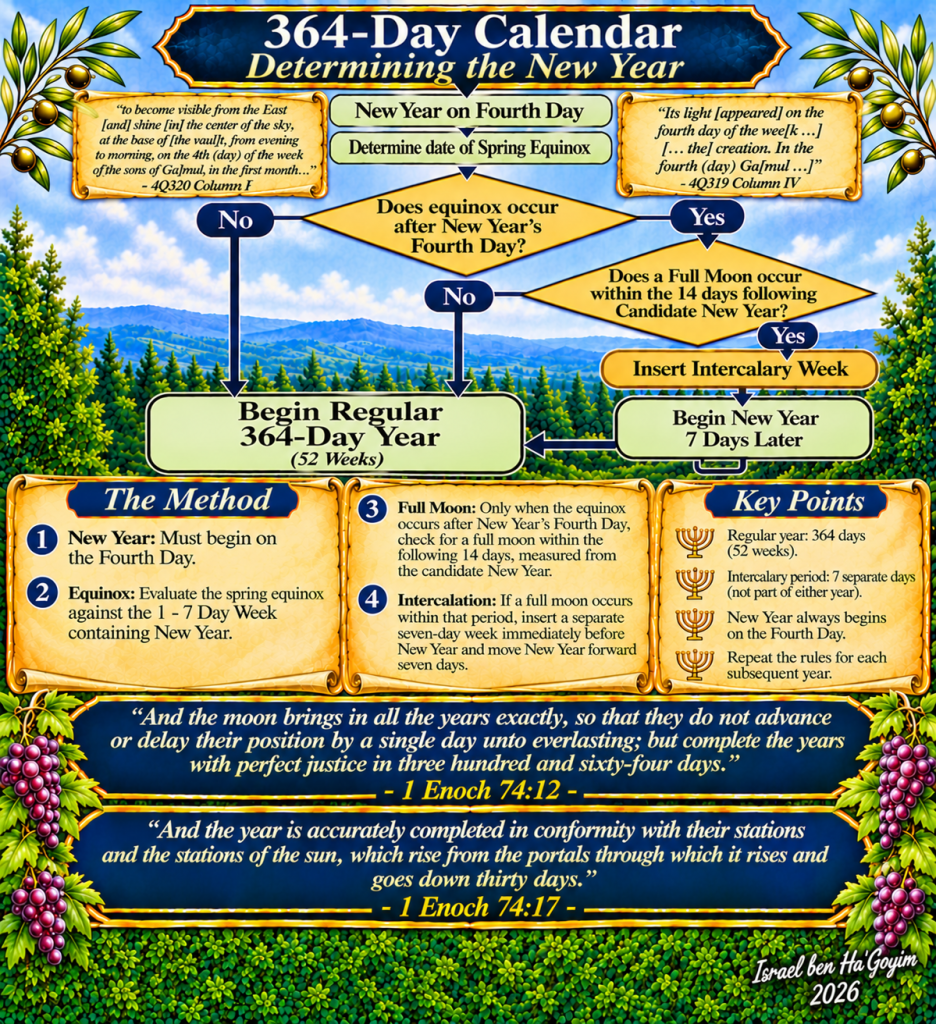
This method suggests a precise way of maintaining the order of the calendar using textual evidence from 1 Enoch, the Dead Sea Scrolls, and other sacred texts to guide this understanding. The 364-day calendar provides a consistent structure of 52 complete weeks, with the Fourth Day serving as the fixed weekday for the beginning of the year. The spring equinox provides the first astronomical signal. When the spring equinox occurs after the candidate Fourth Day, then the following 14-days are examined for the sign of a potential full-moon. When both conditions are satisfied, a separate seven-day intercalary period is inserted, moving the actual beginning of the year forward seven days.
The references in 4Q319 and 4Q320 provide important textual evidence concerning the Fourth Day, while 1 Enoch 74:12 and 74:17 address the relationship between the heavenly bodies and the accurate completion of the year. 1 Enoch 74:10, 74:12, 82:6, and Jubilees 6:32, and 6:38 also provide textual evidence of a 364-day year. The purpose of this method is to bring the weekly structure, the astronomical observations, and the annual calendar into an orderly system that preserves the 364-day year while accounting for the need for periodic intercalation.
The governing principle is straightforward: the year begins on the Fourth Day, the equinox determines whether further verification is necessary, and the full moon determines whether a separate intercalary week must be inserted.
The next investigation is to look at the potential role of the stars…


Leave a Reply