In the previous article the topic of discussion was the role of the moon and sun. 1 Enoch speaks extensively on the role of the stars and well, and Genesis 1:14-16 explicitly mentions the stars, or kokavim. Additionally, 1 Enoch states that there are leaders who are placed over all creation and over all the stars, and who render service on the “four days” (recall the four intercalary days that stand out in each quarter):
“And the leaders of the heads of the thousands, who are placed over the whole creation and over all the stars, have also to do with the four intercalary days, being inseparable from their office, according to the reckoning of the year, and these render service on the four days which are not reckoned in the reckoning of the year.” – 1 Enoch 75:1
Furthermore, 1 Enoch chapter 82 names these four leaders as Melkiel, Helemmelek, Melejal, and Narel. The four intercalary days are the days that are at the end of each quarterly season of the year. The 91st day of the first quarter corresponds closely with the summer solstice, the 182nd day (2nd quarter) corresponds with the autumnal equinox, the 273rd day corresponds with the winter solstice (3rd quarter), and the 364th day corresponds with the spring equinox (4th quarter). 1 Enoch 75 also describes how the sun, moon, and stars are leaders for the day and for the night. For the stars, there are four leaders who are placed over the thousands of stars. The chapter also describes “12 doors” that are “open in the circumference of the sun’s chariot in the heavens.” It is likely that this is a description of the 12 constellations of the Mazzaroth (commonly known as the zodiac), which the sun travels through on the ecliptic.
There are four of the twelve constellations that divide the Mazzartoth into quarters, and correspond with the four quarterly seasons in that one of the brightest stars associated with that constellation is near the meridian at approximately midnight around the turn of each season: Scorpio with the summer solstice, Aquarius (and its associated constellation Pisces Austrinus) with the autumnal equinox, Taurus with the winter solstice, and Leo with the spring equinox. The brightest star in Leo is Regulus, in Scorpio it is Antares, Pisces Austrinus has Fomalhaut, and the brightest star in Taurus is Aldebaran. Could it be that these four stars are the leaders of the heads of the thousands? Collectively these four stars are known as the “Royal Stars” (this is not giving credence to astrology, but astrology does also use this term). Ancient Persian tradition describes four great stars that watch over the heavens, known as celestial watchers or guardians. Are these four stars the celestial guardians that watch over the heavens? This is uncertain, and is deserving of more research.
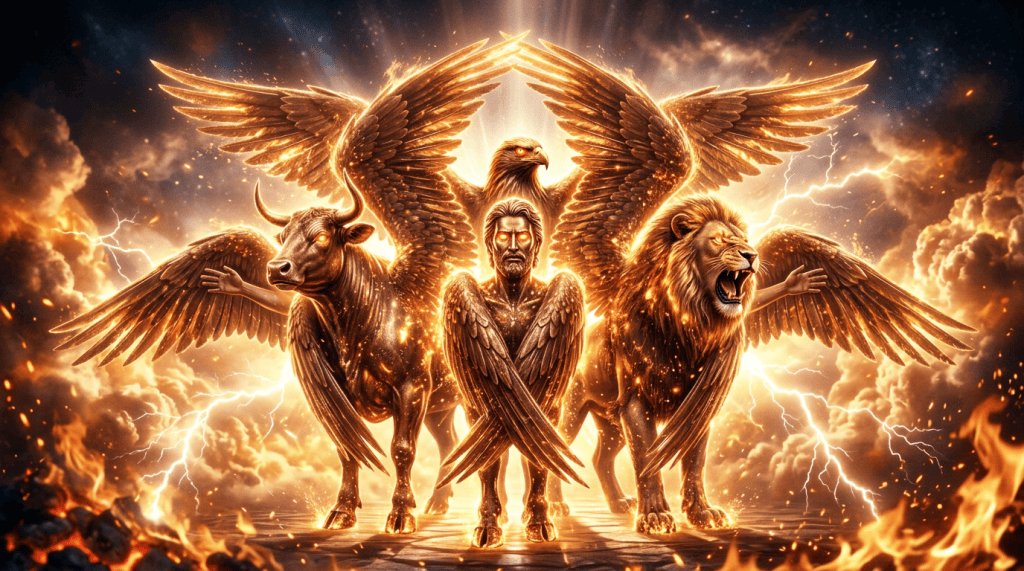
Ancient Mesopotamian astronomy used constellations to identify seasonal changes, and the star-lore was different in many ways that what we have received from the Greeks. Ancient Mesopotamian tradition may identify four constellations that are seasonal dividers: Scorpio, Aquarius, Taurus, and Leo. These four constellations equally divide the twelve into four quarters. In some star-lore, Scorpio is not a scorpion but an eagle. If that is the case then the four constellations are represented as an eagle, a man, a bull (Ox), and a lion. This is significant because there are scholarly discussions of Ezekiel’s chariot vision that identifies these same four constellations in connection with the four living creatures of Ezekiel’s vision that he had while in Babylonian captivity. It should also be noted that the four creatures in the Apostle John’s vision in Revelation also had similar likenesses.
“And the likeness of their faces: the face of a man, and each of the four had the face of a lion on the right side, and each of the four had the face of an ox on the left side, and each of the four had the face of an eagle.” – Ezekiel 1:10
“And the first living creature was like a lion, and the second living creature like a calf, and the third living creature had a face like a man, and the fourth living creature was like a flying eagle.” – Revelation 4:7
Although neither explicitly calls these creatures constellations, both Ezekiel and John (in each respective chapter) express looking into the heavens when receiving their visions. The four creatures of Ezekiel’s vision also have an important feature that is comparable with a cosmic representation of the four quarters of the heavens: they face four directions and move in accordance with the spirit.
Is there a correlation with Enoch’s four leaders that are assigned to each of the intercalary days, Ezekiel’s vision, John’s vision, and the constellations Scorpio, Taurus, Leo, and Aquarius (along with Pisces Austrinus)?
Taken together, these passages present a compelling pattern worthy of further investigation. The book of 1 Enoch describes four leaders associated with the stars and the four intercalary days that distinguish the quarters of the year. Ezekiel describes four living creatures bearing the likenesses of a man, a lion, an ox, and an eagle, positioned in relation to the four directions and moving in accordance with the spirit. The Apostle John later describes four living creatures bearing remarkably similar likenesses before the throne of יהוה. When these descriptions are considered alongside the four prominent seasonal constellations—Aquarius, Leo, Taurus, and Scorpio—and the stars associated with them, a possible connection begins to emerge.
Each source may be preserving a different aspect of an ancient understanding of the heavens: a system in which the stars were not merely lights in the sky, but were understood to have appointed roles within the ordering of creation and the reckoning of time. Although the available evidence does not yet establish that Enoch’s four leaders are the same as the four celestial figures represented in Ezekiel and Revelation, the similarities are substantial enough to warrant further examination. The possibility that these traditions share an older astronomical and calendrical framework should not be dismissed without further investigating their historical and textual connections.
The working hypothesis is that an ancient fourfold celestial framework may underlie the descriptions found in 1 Enoch, Ezekiel, and Revelation. Within this framework, the heavens were organized around four principal seasonal divisions, represented by four prominent constellations: Taurus, Leo, Scorpio, and Aquarius. Their associated celestial figures—the bull, lion, eagle, and man—may provide a possible astronomical counterpart to the four living creatures described by Ezekiel and John. Likewise, the four leaders named in 1 Enoch may represent a related hierarchy of celestial authority, with responsibility for the stars and their appointed functions within the annual cycle. The four intercalary days, positioned in relation to the four quarters of the 364-day year, may provide the calendrical dimension of this same framework. This hypothesis presumes that the four leaders of the stars are identified with Aldebaran, Regulus, Antares, and Fomalhaut. Also, the twelve doors described in 1 Enoch are the twelve constellations of the Mazzaroth, and that these descriptions preserve related elements of an ancient system connecting the movements of the heavenly bodies, the four seasonal quarters, the ordering of the stars, and the measurement of the year. Further research into the astronomical fragments among the Dead Sea Scrolls, Babylonian and Persian celestial traditions, and deeper study into Ezekiel, Revelation, and 1 Enoch may help to unveil more evidence what this shared astronomical tradition truly is.


Leave a Reply