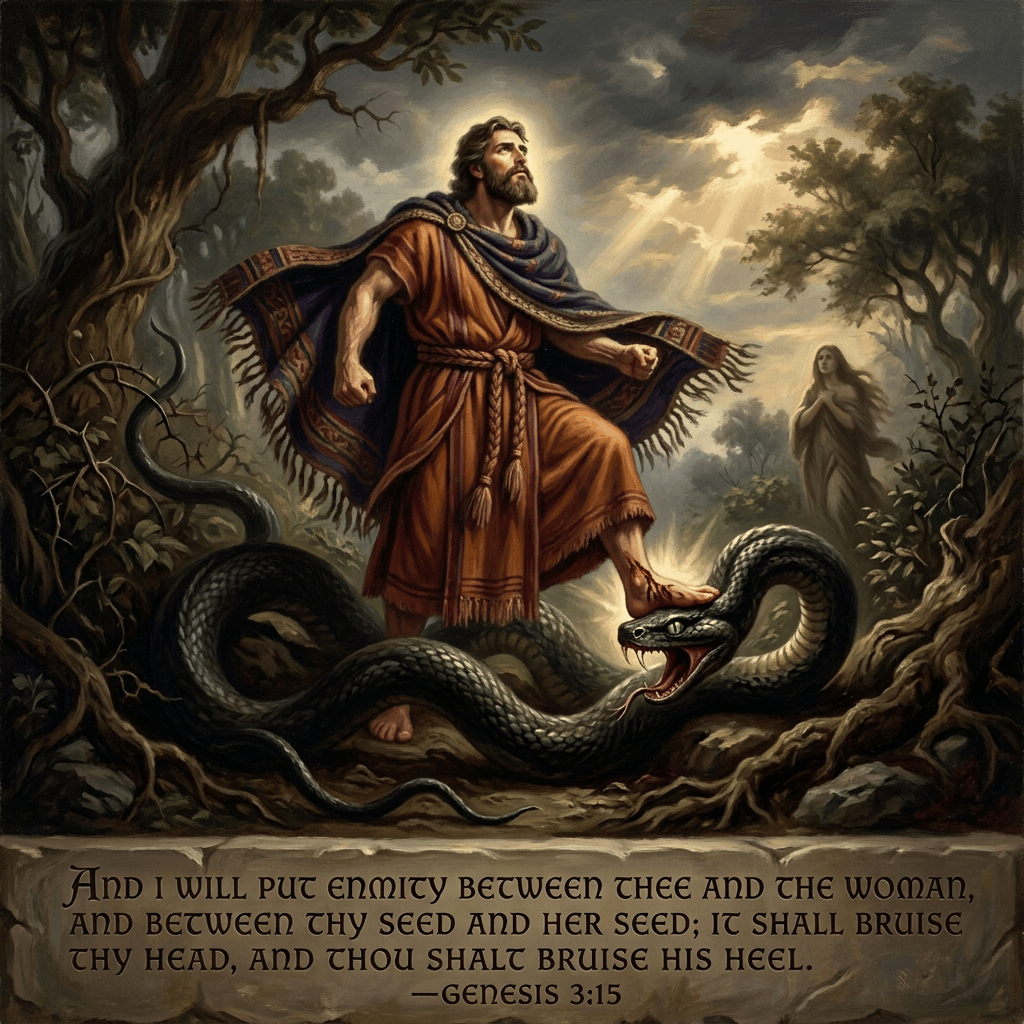
“And I put enmity between you and the woman, and between your seed and her Seed. He shall crush your head, and you shall crush His heel.” – Genesis 3:15
The seed in this prophecy is directly related to the Children of Israel, and the end-times redemption of the Children of Elohim – who are the seed referred to in this verse. The serpent, nachash, or dragon will bruise the hindermost part of the woman’s seed in the latter days. The “heel” of the woman’s seed refers to the children of Jacob, who was named Israel, and the promise made to the seed through Abraham, Isaac, and Jacob.
H6119 עָקֵב `aqeb (aw-kabe’) noun (masculine)
Heel, rear, footprint, hinder part; mark, sign, or trace (as in a footprint in the sand); (figuratively) the rear (of an army); from the root H6117.
H6117 עָקַב `aqab (aw-kab’) verb
To swell up or out (as in the expansion of a nation), or ascend; to circumvent (as if tripping up the heels); to restrain as if holding by the heel – like Jacob did with Esau in Rebecca’s womb.
The seed-line of the woman is recorded in Genesis 5: Adam, Seth, Enosh, Qeynan, Mahalal’el, Yered, Hanok, Methushelah, Lemek, and Noah. Then, in Genesis 11 the seed-line of the woman continues: Shem, Arpakshad, Shelah, Eber, Peleg, Reu, Serug, Nahor, Tarah, and Abram.
Abram’s name was changed to Abraham, and the Covenant was made between him and Elohim, and Abraham’s seed after him:
“As for Me, look, My covenant is with you, and you shall become a father of many nations. And no longer is your name called Aḇram, but your name shall be Aḇraham, because I shall make you a father of many nations. And I shall make you exceedingly fruitful, and make nations of you, and sovereigns shall come from you. And I shall establish My covenant between Me and you and your seed after you in their generations, for an everlasting covenant, to be Elohim to you and your seed after you. And I shall give to you and your seed after you the land of your sojourning, all the land of Kena‛an, as an everlasting possession. And I shall be their Elohim.” And Elohim said to Aḇraham, “As for you, guard My covenant, you and your seed after you throughout their generations.” – Genesis 17:4-9
Abraham fathered Isaac, and Isaac had Jacob.
Jacob, as mentioned before, took hold of his brother’s heel, so Jacob’s name comes from the same word for “heel” עָקַב, only a “yod” is attached as a prefix. The “yod” is also the first letter of the Name: יהוה. Placing the “yod” at the beginning of “heel” can mean “יהוה is with the heel”. The seed passed from Adam and Hawwah through Sheth to Abraham resulted in the one who was the heel that walked with יהוה:
“And after that came his brother out, and his hand took hold on Esau’s heel; and his name was called Jacob (יעקב): and Isaac was threescore years old when she bare them.” – Genesis 25:26.
Jacob’s name is changed to Israel, and the promise made to Abraham and his seed is then made with Israel:
“And He said, “Your name is no longer called Ya‛aqoḇ, but Yisra’ĕl, because you have striven with Elohim and with men, and have overcome.” – Genesis 32:28
“And Elohim said to him, “Your name is Ya‛aqoḇ, your name is no longer called Ya‛aqoḇ, but Yisra’ĕl is your name.” So He called his name Yisra’ĕl. And Elohim said to him, “I am Ěl Shaddai. Be fruitful and increase, a nation and a company of nations shall be from you, and sovereigns come from your body. And the land which I gave Aḇraham and Yitsḥaq I give to you. And to your seed after you I give this land.” – Genesis 35:10-12
Jacob placed his blessing and name on the sons of Joseph:
“And he blessed Yosĕph, and said, “The Elohim before whom my fathers, Aḇraham and Yitsḥaq walked, the Elohim who has fed me all my life long to this day, the Messenger who has redeemed me from all evil – bless the youths! And let my name be called upon them, and the name of my fathers, Aḇraham and Yitsḥaq. And let them increase to a multitude in the midst of the earth.” – Genesis 48:15-16
Furthermore, Jacob prophesied that Ephraim’s seed would become the fulness, or completeness of the nations:
“But his father refused and said, “I know, my son, I know. He (Menashsheh) also becomes a people, and he also is great. And yet, his younger brother (Ephraim) is greater than he, and his seed is to become the completeness of the nations.” And he blessed them on that day, saying, “In you Yisra’ĕl shall bless, saying, ‘Elohim make you as Ephrayim and as Menashsheh!’” Thus he put Ephrayim before Menashsheh.” Genesis 48:19-20
The prophets describe how the seed of “Ephrayim” (used as a term of endearment for the Northern Kingdom of Israel as distinct from the Southern Kingdom of Judah) was scattered to the nations because of their disobedience in breaking the covenant that was made with the children of Israel through Abraham, Isaac, and Jacob.
The Northern Kingdom would fall into idolatry and corruption by disobeying the Commandments of Elohim and being enticed by the little god’s of the nations. They had taken of the tree of the knowledge of good but evil, as their forefathers had. The prophet Jeremiah describes how the Northern Kingdom of Israel was given a certificate of divorce, and that the Southern Kingdom was no better:
“And I saw that for all the causes for which backsliding Yisra’ĕl had committed adultery, I had put her away and given her a certificate of divorce; yet her treacherous sister Yehuḏah did not fear, but went and committed whoring too.” – Jeremiah 3:8
Jeremiah 3 continues, however, to offer a way of return to the Northern Tribes, as well as the Southern: repent and acknowledge their sins, and return to the covenant of their Elohim. Israel would not listen, and instead acted like an adulterous wife:
“as a wife betrays her husband, so have you betrayed Me, O house of Yisra’ĕl,” declares יהוה.” – Jeremiah 3:20
The prophet Hoshea, too, describes this adulterous relationship committed by Ephrayim:
“I have known Ephrayim, and Yisra’ĕl has not been hidden from Me. For now, O Ephrayim, you have whored, Yisra’ĕl is defiled.” – Hoshea 5:3
The prophet continues:
“Ephrayim, what would I do with you? Yehuḏah, what would I do with you? For your loving-commitment is like a morning cloud, and like the early dew it goes away.” – Hoshea 6:4
Ephrayim’s commitments are fleeting, and because of their wickedness they became defiled:
“I have seen a horrible matter in the house of Yisra’ĕl: the whoring of Ephrayim is there, Yisra’ĕl is defiled.” – Hoshea 6:10
All of the prophets agree: Israel and Judah betrayed the covenant made with the Living Elohim. Due to this betrayal both were exiled. First, the Northern Kingdom of Israel by the Assyrians at around 725 B.C., and the Southern Kingdom of Judah by Babylon some years later. Along with the punishment (or curse) there is a promise of return.
(Be sure to read for scriptural references of the Two Kingdom’s becoming united once again: Ezekiel 37:15-28; Isaiah 11 & 43; Jeremiah 3:18, 30 and 31.)
The reuniting of the whole House of the Kingdom of Israel is something that has not happened yet. The prophet Jeremiah speaks of this happening during a time known as the Second Exodus, an event so great that the first Exodus from Egypt will no longer be mentioned. Since the first Exodus from Egypt is still commemorated and discussed every year – particularly at Passover, but also at other times throughout the year – and the occurrence of the second Exodus is not, we can logically conclude that it hasn’t happened yet.
“Therefore see, the days are coming,” declares יהוה, “when it is no longer said, ‘יהוה lives who brought up the children of Yisra’ĕl from the land of Mitsrayim, but, ‘יהוה lives who brought up the children of Yisra’ĕl from the land of the north and from all the lands where He had driven them.’ For I shall bring them back into their land I gave to their fathers.” – Jeremiah 16:14-15
Also, it is the “Branch of Righteousness” and King that will gather the remnant of the flock:
“See, the days are coming,” declares יהוה, “when I shall raise for Dawiḏ a Branch of Righteousness, and a Sovereign shall reign and act wisely, and shall do right-ruling and righteousness in the earth. In His days Yehuḏah shall be saved, and Yisra’ĕl dwell safely. And this is His Name whereby He shall be called: ‘יהוה our Righteousness.’ Therefore, see, the days are coming,” declares יהוה, “when they shall say no more, ‘As יהוה lives who brought up the children of Yisra’ĕl out of the land of Mitsrayim,’but, ‘As יהוה lives who brought up and led the seed of the house of Yisra’ĕl out of the land of the north and from all the lands where I had driven them.’ And they shall dwell on their own soil.” – Jeremiah 23:5-8
“But you, Yisra’ĕl, are My servant, Ya‛aqoḇ, whom I have chosen, the descendants of Aḇraham who loved Me, whom I have strengthened from the ends of the earth, and called from its farthest parts, and said to You, ‘You are My servant, I have chosen you and have not rejected you. Do not fear, for I am with you. Do not look around, for I am your Elohim. I shall fortify you, I shall also help you, I shall also uphold you with the right hand of My righteousness.’” – Isaiah 41:8-10
Turning to the B’rit Chadashah, the Apostle Shaul tells us in the book of Romans that a hardening of the heart has come over Israel until the “fulness of the nations” (that is Ephrayim) has come to mind and entered into the public consciousness:
“For I do not wish you to be ignorant of this secret, brothers, lest you should be wise in your own estimation, that hardening in part has come over Yisra’ĕl, until the completeness of the nations has come in.” – Romans 11:25
It was already establish in Genesis 48 that Ephrayim is to be the “completeness of the nations,” but take a look at the Greek used for “come in”: εἰσέλθῃ (eiselthē) — there are nine occurrences in the New Testament, and it means to enter into something. Here are a few:
“Verily I say unto you, Whosoever shall not receive the kingdom of God as a little child, he shall not enter therein.” – Mark 10:15, Luke 18:17
“And wheresoever he shall go in, say ye to the goodman of the house, The Master saith, Where is the guest chamber, where I shall eat the Passover with my disciples?” – Mark 14:14
“I am the door: by me if any man enter in, he shall be saved, and shall go in and out, and find pasture.” – John 10:9
“And there shall in no wise enter into it anything that defileth, neither whatsoever worketh abomination, or maketh a lie: but they which are written in the Lamb’s book of life.” – Revelation 21:27
Strong’s points to the Greek concordance G1525 εἰσέρχομαι “eiserchomai.” The word means the same as mentioned above: to go out or come in; to enter. It can also mean of entrance into any condition, state of things, society, employment, to arise, come into existence, begin to be of men, to come before the public, to come into life; of thoughts that come into the mind. G1525 is from the root G2064 (“erchomai”) that means: to come (of persons); to come from one place to another, and used both of persons arriving and of those returning; to appear, make one’s appearance, come before the public; (metaphorically) to come into being, arise, come forth, show itself, find place or influence; be established, become known, to come (fall) into or unto; to go, to follow One.
Thus, in Romans 11, while Shaul is admonishing those who are grafted into the Olive Tree of Israel to not be haughty, because hardening in part has come over Israel until the Fulness of the Nations (Ephrayim) makes its public appearance. Again, Shaul tells us in Ephesians that though we were once cut-off from the covenants of promise, that we are now brought into the citizenship of Israel in Messiah Yeshua:
“Therefore, remember that you, once nations in the flesh, who are called ‘the uncircumcision’ by what is called ‘the circumcision’ made in the flesh by hands, that at that time you were without Messiah, excluded from the citizenship of Yisra’ĕl and strangers from the covenants of promise, having no expectation and without Elohim in the world. But now in Messiah יהושע you who once were far off have been brought near by the blood of the Messiah.” – Ephesians 2:11-13
“So then you are no longer strangers and foreigners, but fellow citizens of the set-apart ones and members of the household of Elohim.” Ephesians 2:19
Additionally, Shaul tells us that the promise made to Abraham were given to Messiah Yeshua, and if you are in Messiah, then you are seed of Abraham:
“Messiah redeemed us from the curse of this (works of the) Torah, having become a curse for us – for it has been written, “Cursed is everyone who hangs upon a tree.” – in order that the blessing of Aḇraham might come upon the nations in Messiah יהושע, to receive the promise of the Spirit through belief. Brothers, as a man I say it: a covenant, even though it is man’s, yet if it is confirmed, no one sets it aside, or adds to it, but the promises were spoken to Aḇraham, and to his Seed. He does not say, “And to seeds,” as of many, but as of one, “And to your Seed,” who is Messiah.” – Galatians 3:13-16
“For you are all sons of Elohim through belief in Messiah יהושע. For as many of you as were immersed into Messiah have put on Messiah. There is not Yehuḏi nor Greek, there is not slave nor free, there is not male and female, for you are all one in Messiah יהושע. And if you are of Messiah, then you are seed of Aḇraham, and heirs according to promise.” – Galatians 3:26-29
As the Completeness of the Nations awakens, and Ephrayim comes into the public consciousness, there will be one more bruising of the heel in the midst of a second Greater Exodus. As the Daughter Babylon falls, who is end times Mystery Babylon of the Book of Revelation, the Beast System will rise. The Beast whom the Harlot rides also hates the Harlot, and will eventually destroy her in one hour. When that happens, as Babylon falls, Ephrayim (the House of Israel) will rise, and together with Judah will seek the way back to Tsiyon:
“In those days and at that time,” declares יהוה, “the children of Yisra’ĕl shall come, they and the children of Yehuḏah together, weeping as they come, and seek יהוה their Elohim. They shall ask the way to Tsiyon, their faces toward it, ‘Come and let us join ourselves to יהוה, in an everlasting covenant, never to be forgotten.’” – Jeremiah 50:4-5
The Beast System derives its power and authority from the dragon, that serpent of old, called the devil. This dragon is the same as the nachash from the beginning of the book who deceived Havvah by convincing her that the tree was good, although it was evil. Disobedience to the Creator, which is what sin is, leads to death, and the serpent knows that. From the beginning to the end, he will not stop attempting to crush or bruise the heel of the seed of the woman, the seed of promise: those who are in Messiah Yeshua and guard the Commandments of Elohim.
“And the beast I saw was like a leopard, and his feet were like the feet of a bear, and his mouth like the mouth of a lion. And the dragon gave him his power, and his throne, and great authority. And I saw one of his heads, as having been slain to death, and his deadly wound was healed. And all the earth marvelled after the beast. And they worshipped the dragon who gave authority to the beast. And they worshipped the beast, saying, “Who is like the beast? Who is able to fight with him?” – Revelation 13:2-4
“And the dragon was enraged with the woman, and he went to fight with the remnant of her seed, those guarding the commands of Elohim and possessing the witness of יהושע Messiah.” – Revelation 12:17
The adversary will not prevail, and will be left to the lake of fire. Then there will be a renewed Heaven and a renewed Earth, back to how it was supposed to be in the beginning, Bereshith.
“And I heard a loud voice from the heaven saying, “See, the Booth of Elohim is with men, and He shall dwell with them, and they shall be His people, and Elohim Himself shall be with them and be their Elohim, and Elohim shall wipe away every tear from their eyes, and there shall be no more death, nor mourning, nor crying, and there shall be no more pain, for the former matters have passed away.” He who was sitting on the throne said, “See, I make all matters new.” And He said to me, “Write, for these words are true and trustworthy” And He said to me, “It is done! I am the ‘Aleph’ and the ‘Taw’, the Beginning and the End. To the one who thirsts I shall give of the fountain of the water of life without payment. The one who overcomes shall inherit all this, and I shall be his Elohim and he shall be My son.” Revelation 21:3-7
Even so, come Yeshua! Amein


Leave a Reply