“Before I was afflicted I was going astray, but now I have guarded your word.” – Tehillim 119:67
Yom Kippur, the Day of Atonement, or more accurately, Yom haKippurim – the day of multiple coverings – is most commonly known as a day of repentance and fasting. Both are good, and even beneficial (especially repentance). However, fasting is not really a requirement of Yom haKippurim. Please, before you stop reading, hear me out. Fasting on Yom haKippurim is a tradition that has been passed down, and may even cause Yah’s people to miss the true meaning of the day.
“This shall be a statute for ever unto you: that in the seventh month, on the tenth day of the month, ye shall afflict your souls, and do no work at all, whether it be one of your own country, or a stranger that sojourneth among you: For on that day shall the priest make an atonement for you, to cleanse you, that ye may be clean from all your sins before יהוה. It shall be a Sabbath of rest unto you, and ye shall afflict your souls, by a statute for ever.” – Wayyiqra (Leviticus) 16:29-31 (See also, Leviticus 23, and Numbers 29:7)
“And ye shall do no work in that same day: for it is a day of atonement, to make an atonement for you before יהוה your Elohim. For whatsoever soul it be that shall not be afflicted in that same day, he shall be cut off from among his people. And whatsoever soul it be that doeth any work in that same day, the same soul will I destroy from among his people.” – Wayyiqra 23:28-30
Let us define our terms:
Afflict: Strong’s H6031: “ana” aw-naw: to be afflicted, to stoop down, to be concerned/worried about someone or something, to be humbled, oppressed; to oppress, afflict, humble, mistreat, subdue, to deny oneself, keep oneself busy.
Afflict, or “ana,” is related to other words, which are even spelled exactly the same.
Afflict: Strong’s H6030: “ana” aw-naw: to heed, pay attention; by implication to answer or respond; to sing (or sing about) together by course, give a shout, testify, announce, give account, bear witness; to be answered verbally, response can involve action.
Strong’s H6032: To answer, reply; usually a reaction to a direct question, but it can be a more general response.
Strong’s H6033: Oppressed, needy, poor, implying that such persons are miserable in their situation.
Strong’s H6034 is the name Anah, and Strong’s H6035 means “humble, afflicted, poor, oppressed, meek.”
The soul is “nephesh,” (H5315) which mean breath, life, life force, soul, an immaterial part of a person, the seat of emotion and desire, a creature or person as a whole, the self, body, and even corpse.
Fast: Strong’s 6684 & 6685: “tsum” or “tsome”: to cover over (the mouth); to fast, to voluntarily abstain from frood, as dedication to a deity, as a sign of mourning; medical treatment; time of fasting; act of fasting.
So, we can see that to “afflict your soul,” can mean to humble and deny oneself. Therefore by implication, denying your body food can be a way of afflicting the soul. However, we can also see that to be afflicted is to be concerned or worried about others; it can mean to sing, and give account; to bear witness. This can be accomplished a number of ways – and it doesn’t have to be done through fasting. Yet, it can be accomplished through fasting if it is voluntary, and not compulsory – to afflict yourself does not mean that you have to fast.
This idea that it is a requirement that one must fast on Yom haKippurim is a tradition handed down through religious traditions of men, like those found in the Babylonian Talmud. These rules can be found in Mishnah Yoma 73b and 74b. The Mishnah Yoma says that if someone eats more than “the bulk of a date,” or drinks more than one cheek full of water, that person is liable of breaking the instructions in Leviticus. There are other interesting rules as well, that I am not going to expound upon here since the rabbis have done enough expounding on their own rules. However, if you would like to read more, these Babylonian rabbinic rules can be found at this website, if you would like to read them further: http://juchre.org/talmud/yoma/yoma4.htm#73b (or check out emishnah.com).
Uses of “afflict (H6031)” since “the beginning” from Bereshith forward:
“And he said unto Abram, Know of a surety that thy seed shall be a stranger in a land that is not theirs, and shall serve them; and they shall afflict them four hundred years.” Bereshith (Genesis) 15:13
Indeed it happened, “Therefore they did set over them taskmasters to afflict them with their burdens. And they built for Pharaoh treasure cities, Pithom and Raamses.
But the more they afflicted them, the more they multiplied and grew. And they were grieved because of the children of Israel.” Shemoth (Exodus) 1:11-12. And, Pharaoh refused to be afflicted before Yah, “And Moses and Aaron came in unto Pharaoh, and said unto him, Thus saith יהוה Elohim of the Hebrews, How long wilt thou refuse to humble thyself before me? Let my people go, that they may serve me.” (Shemoth 10:3)
“But Abram said unto Sarai, Behold, thy maid is in thy hand; do to her as it pleaseth thee. And when Sarai dealt hardly with her, she fled from her face.” Genesis 16:6
“And the angel of יהוה said unto her, Return to thy mistress, and submit thyself under her hands.” Genesis 16:9
“And when Shechem the son of Hamor the Hivite, prince of the country, saw her, he took her, and lay with her, and defiled her.” Genesis 34:2
It is even a commandment to not afflict another, “Ye shall not afflict any widow, or fatherless child.” (Exodus 22:22)
“Every vow, and every binding oath to afflict the soul, her husband may establish it, or her husband may make it void.” Bemidbar (Numbers) 30:13
Could this mean that one afflict their soul without fasting? Surely, it does!
“Then I proclaimed a fast there, at the river of Ahava, that we might afflict ourselves before our Elohim, to seek of him a right way for us, and for our little ones, and for all our substance.” Ezra 8:21
However… Isaiah 58
Verses 1-3
“Cry aloud, do not spare. Lift up your voice like a ram’s horn. Declare to My people their transgression, and the house of Ya‛aqoḇ their sins. Yet they seek Me day by day, and delight to know My ways, as a nation that did righteousness, and did not forsake the right-ruling of their Elohim. They ask of Me rulings of righteousness, they delight in drawing near to Elohim. They say, ‘Why have we fasted, and You have not seen? Why have we afflicted our beings, and You took no note?’ “Look, in the day of your fasting you find pleasure, and oppress all your workers.”
Some of the definitions of “ana” (afflict H6032) were to testify, announce, give account, bear witness, to sing. That is what is meant by “Cry aloud, do not spare. Lift up your voice like a ram’s horn. Declare to My people their transgressions.” Even though the nation has delighted in the Torah, Yah does not pay attention to their fasting and affliction. Why? Because, they take pleasure in pointing the finger at and persecuting those who are not fasting as they are; those who are not bearing their heavy yoke of bondage. That is what is meant by “you find pleasure, and oppress all your workers.”
Verses 4-5
“Look, you fast for strife and contention, and to strike with the fist of wrongness. You do not fast as you do this day, to make your voice heard on high.
“Is it a fast that I have chosen, a day for a man to afflict his being? Is it to bow down his head like a bulrush, and to spread out sackcloth and ashes? Do you call this a fast, and an acceptable day to יהוה?”
Those who burden others with a heavy yoke of bondage do such so that they may contend with those whom they oppress to strike them with the fist of wrongness. To point the finger and open their mouths wide against others, and say, “Aha, aha! Our eyes have seen it!” Yet, as the Psalmist says, “Let those who say, “Aha, aha!” Be turned back because of their shame.” The Yom Kippur fast is a fast that is required from men; it is not a fast that the Almighty has chosen. They do not fast to make their voice heard on high; that is “to answer, or respond; to sing together and give account; to testify.” We must begin to ask, why fast on Yom haKippurim? It isn’t required, but it is a yoke of bondage if one is compelled to fast simply because it is tradition. Scripture speaks for itself:
Verses 6-10
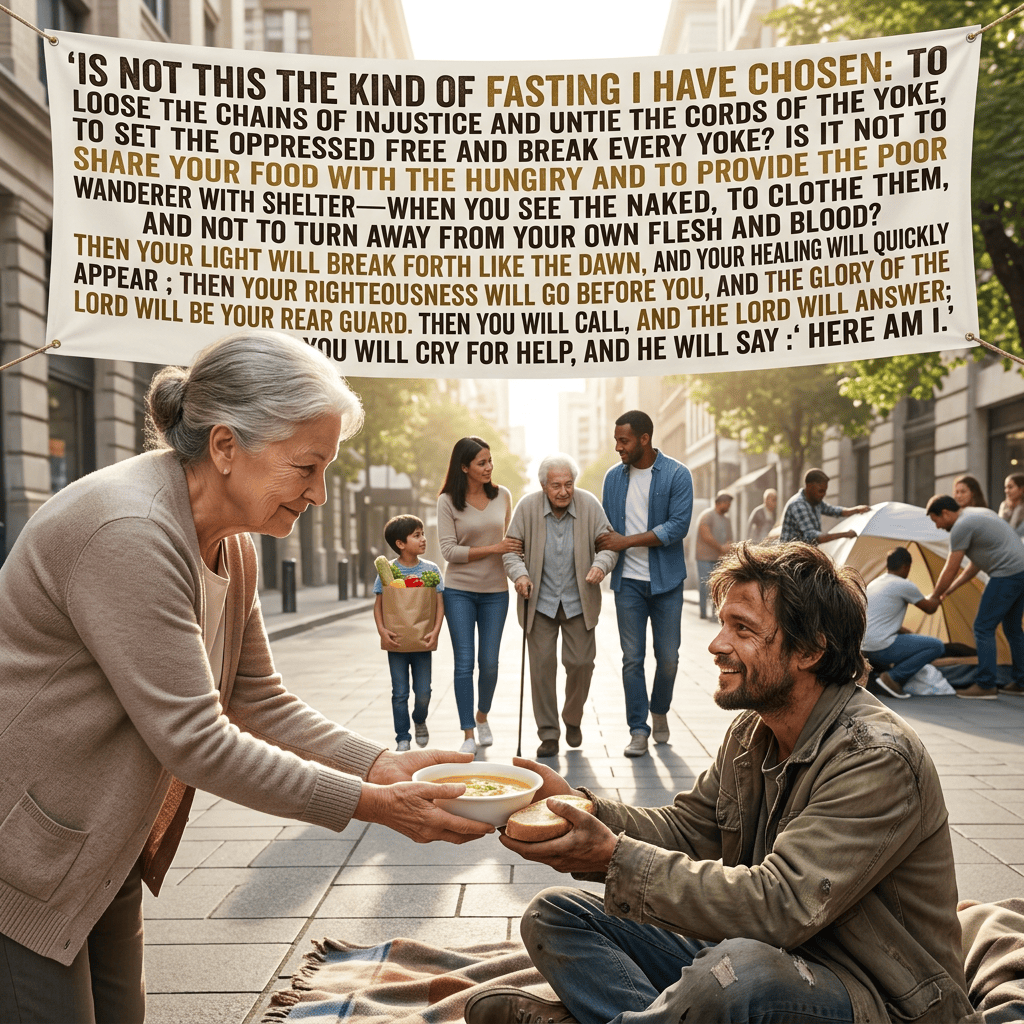
“Is this not the fast that I have chosen: to loosen the tight cords of wrongness, to undo the bands of the yoke, to exempt the oppressed, and to break off every yoke? Is it not to share your bread with the hungry, and that you bring to your house the poor who are cast out; when you see the naked, and cover him, and not hide yourself from your own flesh? Then your light would break forth like the morning, your healing spring forth speedily. And your righteousness shall go before you, the esteem of יהוה would be your rear guard. Then, when you call, יהוה would answer; when you cry, He would say, ‘Here I am.’ If you take away the yoke from your midst, the pointing of the finger, and the speaking of unrighteousness, if you extend your being to the hungry and satisfy the afflicted being, then your light shall dawn in the darkness, and your darkness be as noon.” (Isaiah 58)
To afflict your soul does not mean to fast. Afflicting your soul means to bear witness, to give account, testify; to be concerned for others, share your bread with the hungry, cover the naked, help the poor; to exempt the oppressed. That is the command. If one wants to refrain from eating food while doing these other things, great! Yet, there is no expectation that you or anyone else must fast in order to fulfill some Yom Kippur requirement. However, if you give an account, bear witness, testify, feed the poor, cover the naked, exempt the oppressed, then your light will shine in the darkness, and the hour is dark, my friends.
Now is the time for Yah’s people to truly humble themselves, as Moses was humble (yet, Pharaoh refused to be afflicted before the Almighty), and as the Prophet likened unto Moses was humble:
“Truly, He has borne our sicknesses and carried our pains. Yet we reckoned Him stricken, smitten by Elohim, and afflicted.” Isaiah 53:4
However dark the hour may be, to those who afflict their souls in the truest sense of the Word (not based on traditions, but rather on what scripture says), and who follow Him who bore our sickness and carried our pain, their healing will come speedily! They will have their inheritance:
Isaiah 60:1-14
Arise, shine; for thy light is come, and the glory of יהוה is risen upon thee.
For, behold, the darkness shall cover the earth, and gross darkness the people: but יהוה shall arise upon thee, and his glory shall be seen upon thee. And the nations shall come to thy light, and kings to the brightness of thy rising. Lift up thine eyes round about, and see: all they gather themselves together, they come to thee: thy sons shall come from far, and thy daughters shall be nursed at thy side.
Then thou shalt see, and be bright, and thine heart shall fear, and be enlarged; because the abundance of the sea shall be converted unto thee, the riches of the nations shall come unto thee. The multitude of camels shall cover thee, the dromedaries of Midian and Ephah; all they from Sheba shall come: they shall bring gold and incense; and they shall shew forth the praises of יהוה. All the flocks of Kedar shall be gathered together unto thee, the rams of Nebaioth shall minister unto thee: they shall come up with acceptance on mine altar, and I will glorify the house of my glory.
Who are these that fly as a cloud, and as the doves to their windows? Surely the isles shall wait for me, and the ships of Tarshish first, to bring thy sons from far, their silver and their gold with them, unto the name of יהוה thy Elohim, and to the Holy One of Israel, because he hath glorified thee. And the sons of strangers shall build up thy walls, and their kings shall minister unto thee: for in my wrath I smote thee, but in my favour have I had mercy on thee. Therefore thy gates shall be open continually; they shall not be shut day nor night; that men may bring unto thee the forces of the nations, and that their kings may be brought.
For the nation and kingdom that will not serve thee shall perish; yea, those nations shall be utterly wasted. The glory of Lebanon shall come unto thee, the fir tree, the pine tree, and the box together, to beautify the place of my sanctuary; and I will make the place of my feet glorious. The sons also of them that afflicted thee shall come bending unto thee; and all they that despised thee shall bow themselves down at the soles of thy feet; and they shall call thee, The city of יהוה, The Zion of the Holy One of Israel.”
Also read Isaiah Chapter 64 in this context.
The prophet Nahum was faced with a disparaging task: to deliver a message to Nineveh, the world power of that day. Nahum chapter 3 describes Nineveh as a “city of blood,” and its leaders as drunken merchants, consuming locusts who hide from the light of day; they are shepherds and nobles who are asleep, with wounds that cannot be healed. Nineveh was a city of oppression, and so the prophet speaks:
Though they are as entangled thorns, and as drunkards with their drink, they shall be consumed like stubble thoroughly dried. From you came forth one who plots evil against יהוה, a counselor of worthlessness. Thus said יהוה, “Though they are strong and many, even so, they shall be cut off and pass away. Though I have afflicted you, I afflict you no more. So now I break his yoke from you, and tear off your shackles.” And יהוה has commanded concerning you, “Your name shall no longer be sown. From the house of your idols I shall cut off the carved image and the moulded image. I shall appoint your grave, for you have been of no account.” See, on the mountains the feet of him who brings good news, who proclaims peace! O Yehuḏah, observe your festivals, perform your vows. For Beliya‛al shall no more pass through you. He has been cut off completely.” Nahum 1:10-15
Of Nineveh, it is said that there were “many wounded, and a mass of dead bodies, and no end of corpses, they stumble over the corpses – because of the many whorings of the well-favored whore, the mistress of sorceries, who sells nations by her whorings, and clans by her sorceries.” (v. 3:3-4) There is another, end time nation, referred to as the Daughter of Babylon or Mystery Babylon, who is proud, oppressive, and idolatrous (Jeremiah 50). This end-time Babylon makes the nations drunk, and has wounds that are not healed (Jeremiah 51, Revelation 14) She is a mistress, and a proud nation and filled with violence, the merchants and kings of the earth will mourn over her loss. (Revelation 18)
Who are the humble servants who will bear witness to this end-times mistress? Who will heed the call and respond to the Almighty? Maybe her wound could be healed, and the wicked come to repentance, as with Nineveh:
“And the men of Ninewĕh believed in Elohim, and proclaimed a fast, and put on sackcloth, from the greatest to the least of them.” Jonah 3:5
There is nothing wrong with fasting, especially if one is fasting because they are ashamed of their sin. The difference is between fasting voluntarily and compulsory fasting based on traditions that require fasting where fasting isn’t required from the Almighty El Shaddai! What is required is to feed the poor, give peace to the oppressed, and break the yoke of bondage. Why do you break the commandments of Elohim because of your tradition?
In 2 Samuel chapter 12, King David fasted after Nathan the prophet declared YHWH’s judgment against the infant child brought forth from his adulterous relationship with Bathsheba. This was a fast of sackcloth and ashes, a naham repentance rather than a shuv repentance. Naham means to be grieved and to change ones mind. David realized that his sin was extremely displeasing and abhorrent, this led to his fasting; similar to why the men of Ninevah fasted.
On the flip-side, there is an example of a compulsory fast found in 1 Kings chapter 21. In this chapter Jezebel, wicked King Ahab’s unscrupulous wife, proclaims a fast so that the men of Beliya’al could point a false finger at Naboth and say, “Aha! Naboth is not fasting!” Naboth was subsequently stoned to death, and Ahab received the vineyard that he wanted. To know more about this story, read 1 Kings 21.
There is a time for fasting, even for declaring a fast throughout the land, when a people have realized their sin, when they are grieved and have a change of heart (naham). This change of mind and realization of sin leads one to the repentance of return, or shuv: returning to the way of Elohim. So the repentance of naham and the repentance of shuv can be expressed through fasting. There are also fasts that people will begin in order to appeal to Elohim (as in Esther’s case). Examples of these kinds of fast can be found in 2 Chronicles 20:3, Ester 4:16, Jeremiah 36:9, Joel 1:14, Joel 2:15.
It was good for me that I was afflicted, that I might learn Your laws. (Psalm 119:71) We can either afflict ourselves, or we will be afflicted one way or another no matter what anyways. When we are afflicted, it is meant to lead us to repentance so that we can learn the laws of Elohim. I know, O יהוה, That Your right-rulings are righteous, and in trustworthiness You have afflicted me. (Psalm 119:75) External affliction is meant to lead us to repentance, repentance leads us to the Torah, and the Torah teaches us internal affliction: love, joy, peace, patience, kindness, goodness, gentleness, self-control, to be humble, to help others, to feed the poor, visit the orphan and widow, to cover the naked. When we come to repentance, we are revived by the Holy Spirit and Word of Yahweh. As we afflict our very souls, the Spirit grows within us, producing fruit. I have been afflicted very much; O יהוה, revive me according to Your word. (Psalm 119:107)
There are fasts that are declared for all the wrong reasons, too. As we have seen in the case of Jezebel’s fast. In Jeremiah chapter 14, starting in verse 11, Yahweh says to the prophet Jeremiah, “Do not pray for this people for their good. When they fast, I do not hear their cry. And when they offer burnt offering and grain offering, I do not accept them. Instead, I am consuming them by sword, and by scarcity of food, and by pestilence.”
We have to be careful to make sure that our fasts are fasts for Yahweh, and not because others have said that it is something that we have to do. “When you fasted and lamented in the fifth and seventh months all these seventy years, did you truly fast for Me – for Me?” says the prophet Zechariah (chapter 7, verse 5). “Thus said יהוה of hosts, ‘Execute true right-ruling, show kindness and compassion everyone to his brother. Do not oppress the widow or the fatherless, the stranger or the poor. And do not plot evil in your hearts against one another.” (verses 9 and 10)
In conclusion, this is not to condemn fasting, or to even condemn fasting on Yom Kippurim. If one wants to fast on Yom Kippur, or any other day, then let them fast. However, it is wrong to teach that people must fast on Yom Kippur. Fasting on Yom Kippur is a religious tradition of men with special rules about what is considered a fast. If one were to break this custom, then they could be shamed within the community, and by the religious leaders. This is not a fast declared by Yahweh. Afflicting your soul on Yom haKippurim does not mean fasting.
Yom haKippurim means day of coverings where we as believers are to respond and bear witness with love and compassion by feeding the hungry, covering the naked, not oppressing the widow or the fatherless. We show concern for others and give our testimony by executing right-ruling, showing kindness and compassion everyone to his brother. By this the world will know that we are B’nai El Chai – children of the Living God – and many will come to repentance when they witness this testimony on the day of coverings, when our sins are covered over.
James 5:19-20: “Brothers, if anyone among you goes astray from the truth, and someone turns him back, let him know that he who turns a sinner from the straying of his way shall save a life from death and cover a great number of sins.”
1 Peter 4:8: “And above all have fervent love for one another, because love covers a great number of sins.”


Leave a Reply