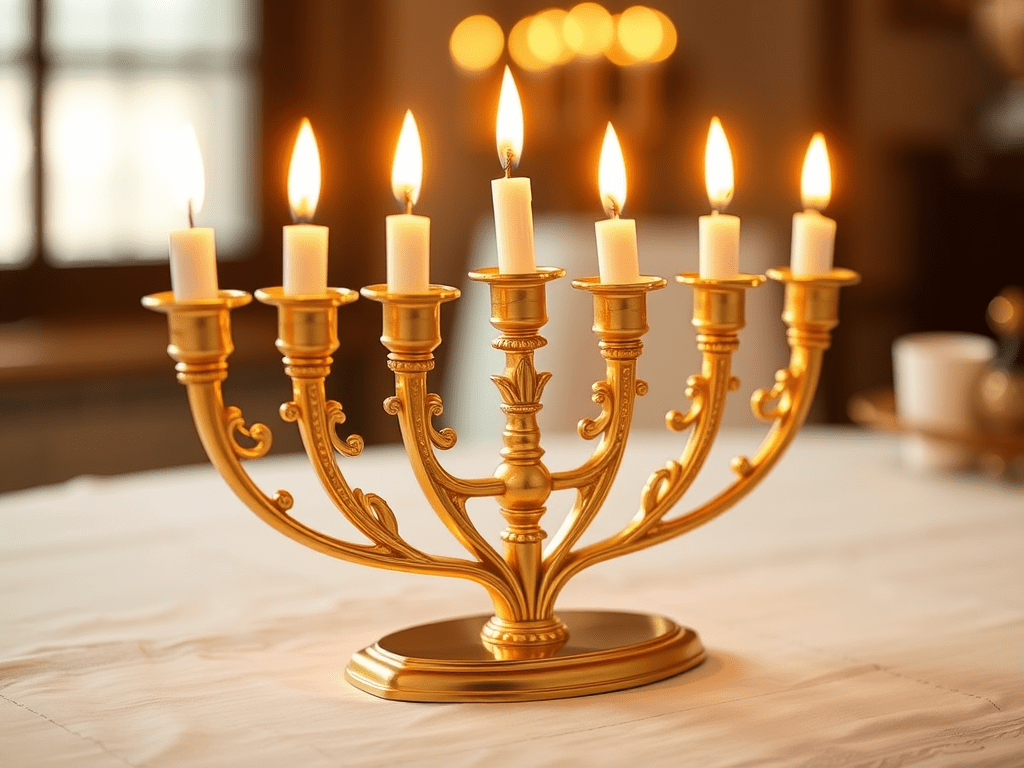
The Menorah: the lampstand described in Exodus chapter 25, was a beautifully hand-crafted work designed from pure gold, and weighing 75 pounds, or one talent. In the description of the menorah in Torah portion Terumah (specifically verses of Exodus 25:31-40) it’s branch (or branches) are mentioned twelve times. These verses also mention cups made like almond flowers on each branch, three cups on each of the six branches, plus four more on the main lamp for a total of twenty-two almond-shaped cups.
“And you shall make a lampstand of clean gold – the lampstand is made of beaten work. Its shaft and its branches (1), its cups, its ornamental knobs and blossoms are from it, and six branches (2) shall come out of its sides: three branches (3) of the lampstand out of one side, and three branches (4) of the lampstand out of the other side; three cups made like almond flowers on one branch (5), with ornamental knob and blossom, and three cups made like almond flowers on the other branch (6), with ornamental knob and blossom – so for the six branches (7) coming out of the lampstand. And on the lampstand itself are four cups made like almond flowers, with ornamental knob and blossom, and a knob under the first two branches (8) of the same, and a knob under the second two branches (9) of the same, and a knob under the third two branches (10) of the same, according to the six branches (11) coming out of the lampstand. Their knobs and their branches (12) are of the same – all of it one beaten work of clean gold. And you shall make seven lamps for it, and they shall mount its lamps so that they give light in front of it. And its snuffers and their trays are of clean gold. It is made of a talent of clean gold, with all these utensils. So see, and do according to the pattern which was shown to you on the mountain.” – Exodus 25:31-40
The Hebrew word used for branches in these verses in qane, Strong’s H7070, and can refer to a reed, stock, bone, balances, branch, etc. It’s also the qane bosem used in the anointing oil described in Exodus 30:23, which the King James Version (and others) translate as calamus, an erroneous translation, but that’s a digression…
This idea of qane being equated with bone, or the human body, is important. Job 31:22 says: “Let mine arm fall from my shoulder blade, and mine arm be broken from the bone (H7070).” The branches of the menorah are like the bones of an arm, stretching out and providing light – a light that never went out. Interestingly, the King James Version personifies the menorah in Exodus 25:31:
“And thou shalt make a candlestick of pure gold: of beaten work shall the candlestick be made: his shaft, and his branches, his bowls, his knops, and his flowers, shall be of the same.”
The number 12 represents the tribes of the Children of Israel, who were to be a light to the nations, modeling the will of Yah to the nations so that the nations could be reconciled back to their Creator. The menorah is symbolic of a people who are to be a light in times of darkness. According to the Prophet Isaiah, this “Light to the Nations” seems to have messianic implications as well:
“Behold my servant, whom I uphold; mine elect, in whom my soul delighteth; I have put my spirit upon him: he shall bring forth judgment to the nations. He shall not cry, nor lift up, nor cause his voice to be heard in the street. A bruised reed shall he not break, and the smoking flax shall he not quench: he shall bring forth judgment unto truth. He shall not fail nor be discouraged, till he have set judgment in the earth: and the isles shall wait for his law. Thus saith Elohim YHWH, he that created the heavens, and stretched them out; he that spread forth the earth, and that which cometh out of it; he that giveth breath unto the people upon it, and spirit to them that walk therein: I YHWH have called thee in righteousness, and will hold thine hand, and will keep thee, and give thee for a covenant of the people, for a light of the Nations. To open the blind eyes, to bring out the prisoners from the prison, and them that sit in darkness out of the prison house.” – Isaiah 42:1-7
When John the Baptist sent his disciples to Yeshua to ask if he was the coming Messiah in Matthew chapter 11, part of Yeshua’s response was “the blind receive their sight,” fulfilling the prophecy of Isaiah, that the One coming to be the Light to the Nations would also be the One who heals, and who would be bruised and striped for our transgressions. Matthew 12:18-21 also specifically addresses the prophecy in Isaiah 42:1 – 7.
Isaiah 49:6 continues this prophetic symbolism: “and He says, “Shall it be a small matter for You to be My Servant to raise up the tribes of Jacob, and to bring back the preserved ones of Israel? And I shall give You as a light to the nations, to be My deliverance to the ends of the earth!”
The Master Yeshua taught the disciples in the Gospel of Matthew, chapter five, verses 14-16, “You are the light of the world. It is impossible for a city to be hidden on a mountain. Nor do they light a lamp and put it under a basket, but on a lampstand, and it shines to all those in the house. Let your light so shine before men, so that they see your good works and praise your Father who is in the heavens.”
According to the Book of Romans, chapter 11, we are branches of the Olive Tree of Israel, whether natural or grafted-in wild branches, we are nevertheless branches. The prophet Zechariah also mentions menorah and olive trees, as does the Book of the Revelation of Yeshua Ha’Mashiach. In these two books, lampstands and olive trees are symbolic for people, or groups of people – a qahal, or assembly.
“And he said to me, “What do you see?” So I said, “I have looked, and see: a lampstand all of gold with a bowl on top of it, and on the stand seven lamps with seven spouts to the seven lamps. And two olive trees are by it, one at the right of the bowl and the other at its left.” – Zechariah 4:2-3
“Then I responded and said to him, “What are these two olive trees, one at the right of the lampstand and the other at its left?” And I responded a second time and said to him, “What are these two olive branches which empty golden oil from themselves by means of the two gold pipes?” And he answered me and said, “Do you not know what these are?” And I said, “No, my master.” And he said, “These are the two anointed ones, who stand beside the Master of all the earth.” – Zechariah 4:11-14
The two olive trees are two anointed ones who pour oil into the lampstand. “Anointed ones” is ha’yitzar and means one who closes in with pressure. These anointed ones provide oil to the menorah during times of great pressure, so that the menorah can provide light to the Nations. Zechariah 3:8 says that these are men of symbol.
According to the Book of the Revelation of Yeshua Ha’Mashiach, the lampstands represents the assemblies, or qahal; the congregation of believers to whom the Master said, “You are to be the light of the world.”
“The secret of the seven stars which you saw in My right hand, and the seven golden lampstands: The seven stars are messengers of the seven assemblies, and the seven lampstands which you saw are seven assemblies.” – Revelation 1:20
Also, according to the Book of Revelations, the Two Witnesses are Two Olive Trees and Two Lampstands, which would make them two groups made up of the children of Israel:
“And I shall give unto my two witnesses, and they shall prophesy one thousand two hundred and sixty days, clad in sackcloth. These are the two olive trees and the two lampstands that are standing before the Elohim of the earth.” – Revelation 11:3-4.
These are clad in sackcloth during times of intense pressure and darkness, but they provide the Light of Messiah and the message of Salvation right up until the end.
At the beginning of this article, I mentioned that there are twenty-two almond-shaped cups. Twenty-two is the number of letters in the Hebrew Alef-Bet. The first letter being the Alef, and the last letter is the Tav. Almond flowers representing the anointed High Priest, as indicated by Aaron’s flowering rod. Our High Priest said that He is the Alef and the Tav, the First and the Last, and He is walking in the midst of the seven golden lampstands, just like the almond-shaped cups on the branches of the menorah. He has made us a nation of priests and kings to His Elohim and Father to whom belongs esteem and rule forever. Let our light shine brightly in times of darkness, and let the pressures we face provide oil that causes the menorah to burn continually. Amen.
“And you, you are to command the children of Israel to bring you clear oil of pressed olives for the light, to cause the lamp to burn continually.” – Exodus 27:20

 The Wilderness Assembly
Leave a comment