“And this is the witness of John, when the Jews sent priests and Levites that they might ask him, Who are you? And he acknowledged and did not deny; yea, he acknowledged, “I am not the Messiah.” And they asked him, “What, then? Are you Elijah?” And he said, “I am not.” “Are you the Prophet?” And he answered, “No.” Then they said to him, “Who are you, that we may give an answer to those sending us? What do you say about yourself?” He said, “I am a voice crying in the wilderness: ‘Make straight the way of YHWH,’ as Isaiah the prophet said.” And those who had been sent were of the Pharisees. And they asked him and said to him, “Why then do you baptize, if you are not the Messiah, nor Elijah, nor the Prophet?” John answered them, saying, “I baptize in water, but One stands in your midst whom you do not know. This One it is who has come after me, who has been before me, of whom I am not worthy that I should loose the thong of His sandal.” These things took place in Bethabara beyond the Jordan, where John was baptizing.
(Joh 1:19-28)
There is a theory that is growing in prominence that the archaeological site located by the Dead Sea, now known as Qumran, was John the Baptist’s community and library. There are quite a few studies out there to read-up on this topic if anyone wants to dig in to it, but I will link to a few, here, here, and here. I happen to fall into the category of those who think that Qumran was indeed John the Baptist’s residence. This is a topic that I would at times allude to during Sabbath Bible fellowship at our local congregation sometime ago… awhile before the craziness of 2020 – time has seemed to move so fast since then… I digress. There is a text in the Dead Sea Scrolls called 4Q521 “A Messianic Apocalypse”, or “Redemption and Resurrection”, that provides more evidence that not only was John the Baptist likely part of the community at Qumran – if not their leader – but also that Yeshua the Messiah was familiar with the group as well.
This teaching, that John the Baptist was based out of Qumran, has become a focal point for some more well-known Torah observant teachers as of late, particularly Eddie Chumney, Monte Judah, and Avi Ben Mordechai, who all started openly promoting this teaching earlier in 2024. Praise YAH for their platform to reach people with this message.
Recently, I was reading through the Dead Sea Scrolls while trying to find (unsuccessfully) any texts that support a dawn-to-dawn day. There is a prominent mantra regarding the calendar found at Qumran, and that is that their calendar reckons a 24-hour period as being from dawn-to-dawn rather than evening-to-evening, as is more typical of a Hebrew understanding of a “day”. So, in my quest for knowledge of the truth, I was searching the texts for any evidence that supports this idea. I am only interested in the truth, and doing things YAH’s way. If I’m doing something wrong, then I want to know so that I can repent and change my ways to be inline with His. The only texts that I found seem to support an evening-to-evening, particularly the Damascus Document (also knows as the Zadokite Document) and one called “Daily Prayers” (4Q503). That is a topic for an upcoming article.
While going through the various texts, I came across one in particular, 4Q521, that seemingly gives credence to the thought that Qumran was indeed John the Baptist’s community, and that they were waiting in expectation for the Messiah. 4Q521 “A Messianic Apocalypse” or “Redemption and Resurrection” says this:
1 [for the heav]ens and the earth will listen to His Messiah,
2 [and all th]at is in them will not turn away from the precepts of the holy ones.
3 Strengthen yourselves, you who are seeking the Lord, in his service! [blank]
4 Will you not in this encounter the Lord, all those who hope in their heart?
5 For the Lord will consider the pious, and call the righteous by name,
6 and his spirit will hover upon the poor, and he will renew the faithful with his strength.
7 For he will honour the pious upon the throne of an eternal kingdom,
8 freeing prisoners, giving sight to the blind, straightening out the twis[ted.]
Compare that last verse in “A Messianic Apocalypse,” to what Yeshua says to John the Baptist’s disciples in Luke chapter 7, which says:
“And John, calling two of his disciples to him, sent them to the Lord, saying, “Are you the one who is to come, or shall we look for another?” And when the men had come to him, they said, “John the Baptist has sent us to you, saying, ‘Are you the one who is to come, or shall we look for another?’” In that hour He healed many people of diseases and plagues and evil spirits, and on many who were blind He bestowed sight. And He answered them, “Go and tell John what you have seen and heard: the blind receive their sight, the lame walk, lepers are cleansed, and the deaf hear, the dead are raised up, the poor have good news preached to them. And blessed is the one who is not offended by me.” (Luk 7:18-23)
Yeshua knew when He was answering John the Baptist’s disciples that they would be familiar with what He was saying. He understood that they believed the Messiah would free prisoners, give sight to the blind, and straighten out the twisted, as 4Q521 “A Messianic Apocalypse” says. They also believed that John was the voice of one crying, in the wilderness as we saw in John 1:19-28, and also in Matthew chapter 3.
Compare 4Q521 to these verses from Isaiah:
“Let the wilderness and the dry place be glad for them, and let the desert rejoice, and blossom as the rose. It blossoms much and rejoices, even with joy and singing. The esteem of Lebanon shall be given to it, the excellence of Karmel and Sharon. They shall see the esteem of YHWH, the excellency of our Elohim. Strengthen the weak hands, and make firm the weak knees. Say to those with anxious heart, “Be strong, do not fear! See, your Elohim comes with vengeance, with the recompense of Elohim. He is coming to save you.” Then the eyes of the blind shall be opened, and the ears of the deaf be opened. Then the lame shall leap like a deer, and the tongue of the dumb sing, because waters shall burst forth in the wilderness, and streams in the desert. And the parched ground shall become a pool, and the thirsty land springs of water – in the home for jackals, where each lay, grass with reeds and rushes. And there shall be a highway, and a way, and it shall be called “The Way of Set-apartness.” The unclean does not pass over it, but it is for those who walk the way, and no fools wander on it.” (Isa 35:1-8)
Interestingly, the community at Qumran referred to themselves as Children of Light, Sons of Light, and Sons of Righteousness who have chosen “the Way” (1QS, 4Q255-264a, 5Q11). Similarly, the apostle Paul in Acts 24:14 says, “But I confess this to you that according to the Way, which they say is a sect, so I worship the ancestral God believing all things according to that having been written in the Law and the Prophets.” That’s for another article as well.
The above excerpt from Isaiah 35 speaks about “the wilderness” which the community in Qumran believed referred to the location where they were. The Qumran community, like John the Baptist, directly reference Isaiah 40:3, as read in DSS 4Q528 “Community Rule,” in column 8: “And when these have become a community in Israel in compliance with these arrangements, they are to be segregated from within the dwelling of the men of sin to walk to the desert in order to open there His path. As it is written: “In the wilderness, prepare the way of YHWH, straighten in the steppe a roadway for our God.”
This same verse from Isaiah 40:3 was used in Matthew chapter 3 (like John 1) when describing John the Baptist:
And in those days Yohanan the Immerser came proclaiming in the wilderness of Yehudah, and saying, “Repent, for the reign of the heavens has come near!” For this is he who was spoken of by the prophet Yeshayahu, saying, “A voice of one crying in the wilderness, ‘Prepare the way of YHWH, make His paths straight.”
(Mat 3:1-3)
Matthew says “in the wilderness of Yehudah,” and John’s gospel says that it was near Bethabara. A mosaic found in Amman, Jordan, called the “Madaba Map” is the oldest known map of the Holy Land, and shows the town of Bethabara to the northeast of Jerusalem on the west bank of the Jordan River, in what could be known as the wilderness of Judea.
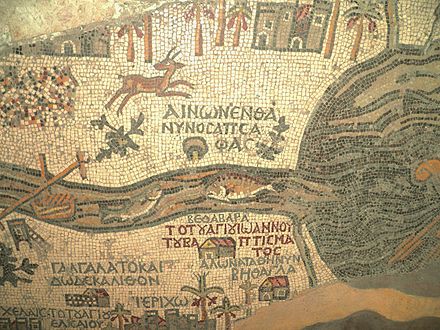
It appears that the Prophet Isaiah’s writing’s were popular in Qumran, as well as with John the Baptist, and with Yeshua the Messiah. A couple of other references to opening the eyes of the blind and freeing prisoners can be found in Isaiah chapters 42 and 61:
“I am YHWH; I have called you in righteousness; I will take you by the hand and keep you; I will give you as a covenant for the people, a light for the nations, to open the eyes that are blind, to bring out the prisoners from the dungeon, from the prison those who sit in darkness.” (Isa 42:6-7)
“The Spirit of the Master YHWH is upon Me, because YHWH has anointed Me to bring good news to the meek. He has sent Me to bind up the broken-hearted, to proclaim release to the captives, and the opening of the prison to those who are bound.” (Isa 61:1)
Yeshua the Messiah even quoted Isaiah 61:1 when He read in the synagogue in Nazareth on the Sabbath day. Here He is quoting a verse that, again, directly refers to releasing prisoners. In Luke’s gospel, the Master makes a statement similar to when He spoke to John the Baptist’s disciples – giving sight to the blind, and releasing prisoners – leaving a theme woven between these and the previous verses referenced:
“The Spirit of YHWH is upon Me, because He has anointed Me to bring the Good News to the poor. He has sent Me to heal the broken hearted, to proclaim release to the captives and recovery of sight to the blind, to send away crushed ones with a release.” (Luk 4:18)
Reading these verses shows how Yeshua used the exact same type of language from scripture to assert His anointing that 4Q521 uses: “freeing prisoners, giving sight to the blind, straightening out the twis[ted.]” Moreover, Yeshua knew which texts John the Baptist and those with him “in the wilderness” at Qumran were familiar with as well when He told them, “Tell John what you have seen and heard: the blind receive their sight, the lame walk.” When John the Baptist’s disciples came to Yeshua, He knew just what to say to them, because He knew exactly what they were looking for, and He performed those very same miracles, leaving no doubt in their minds that He was Mashiach!

 The Wilderness Assembly
Leave a comment